
“Incoterms”: the query gets more than 300,000 search hits on Google a month – clearly it’s a subject that raises plenty of questions for both buyers and sellers when it comes to writing their commercial contracts. You will find many theoretical explanations of Incoterms, based on the definitions and rules of interpretation published by the International Chamber of Commerce. But we’d also like to bring you the operational point of view of a freight forwarder, and in particular our experience with the EX Works Incoterm.
Incoterms and push/pull strategy.
The minimum you need to know as an exporter or importer:
- The Incoterm serves to establish where and how the shipping risks and costs are transferred from the seller to the buyer.
- So, an Incoterm should, by necessity, include a placeand some complementary optional information (e.g. “DAP Container Free Station Johannesburg excluding unloading charges”).
- The person who is covering the costs, the one who covers the main transport according to the Incoterm, is the person who should decide upon the shipping (method, time-frame, service provider). The important question is then who is covering the costs:the buyer or the seller?
Selecting an Incoterm is making a strategic decision in terms of logistics: should you be working in push or pull strategy?
- Using a push strategy (push) means the seller pays and decides on the method of shipping – the seller’s aim is to sell as quickly as possible.
- In pull mode, the buyer decides on transport and pays at destination, in order to control his supply chain according to his needs ( just-in-time, just-in-time…).
Pull Incoterms account for nearly 70% of the market. We recommend FCA and FOB, but not EXW. This is why.
Why should you avoid export sales using the Ex Works (EXW) Incoterm?
The EXW incoterm means Ex Works, which means “upon exiting the factory”. This incoterm means that the seller makes their merchandise available to the buyer outside of their factory. The buyer takes on all the shipping and customs costs and any risks linked to transporting the goods to the destination.
The EXW Incoterm may seem like a great option for exporters: you’ll benefit from reduced costs and liability. However, it’s a dangerous option.
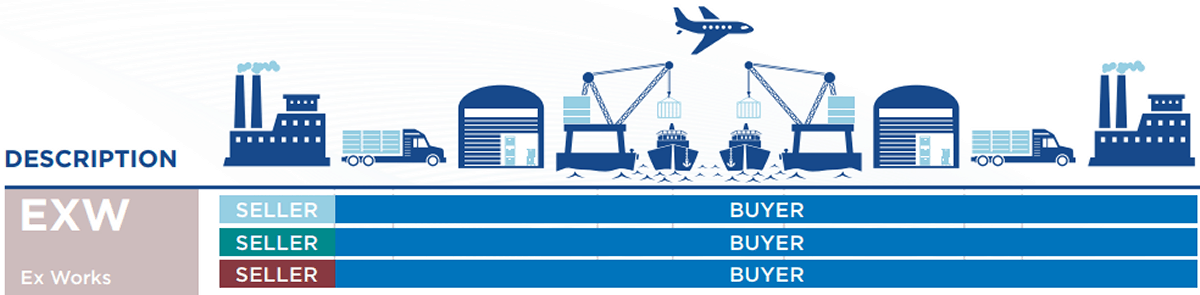
An example of a French exporter.
In France, with an EXW incoterm, it is customary for the French exporter to invoice duty-free, and to appear as the exporter on the Single Administrative Document (SAD)
If you’re exporting from France, you’ll need to collect the export SAD, or keep alternative proof that the goods have left the customs territory of the European Union. The problem is that you have no control over export customs formalities, nor over the choice of customs representative. And yet, it is you who appears on the SAD as the exporter, and is therefore responsible for tax and customs matters!
The risks are as follows:
- Without a SAD or alternative proof of leaving the EU customs territory, the exporter’s billing without taxes will be denied during a tax inspection.
- Without being in control of the information written on the SAD (nomenclatures, value, origin), these could be wrong and leave the exporter open to customs litigation.
- The exporter is obliged to make his merchandise available packaged suitably for shipping (parcel or palet). Often he must also load the lorry that’s been sent by the buyer himself, so he’ll need personnel to do this, which could put his employees at risk.