

Home Blog Operations Crisis in the Middle East 2026: impact on freight transport and advice for shippers
Crisis in the Middle East 2026: impact on freight transport and advice for shippers
The crisis in the Middle East is having a brutal impact on international transport, with blockades, road closures and rising costs. Analysis and advice for shippers on securing goods flows.
- Frédéric Mercier
- Air freight, International, Sea freight
The escalation of the military conflict in the Middle East since February 28, 2026 has disrupted global logistics routes. Importing and exporting companies must immediately adapt their transport strategy.
Update
Airports, airlines and shipping companies, security measures and tariff impacts: our updated status report on freight transport via the Gulf here
Quick Tips for Logistics Professionals
- The military escalation in Iran andthroughout the Arabian Peninsula is causing a systemic shock to the main logistics hub linking Europe, Asia and the rest of the world, with brutal and lasting repercussions on international supply chains.
- Maritime transport under extreme strain : the dangers on the Suez Canal mean that it has to be bypassed via the Cape of Good Hope (+10 to +15 days), reducing available capacity and leading to a surge in overloads (ECS/WRS) of up to $4,000 per container.
- Choc capacitaire aérien et congestion régionale : la fermeture de hubs de Dubaï et Doha a provoqué une rupture soudaine des échanges entre l’Union Européennes et le reste du monde, tout particulièrement vers l’océan Indien et l’Asie du Sud-Est . La réduction massive (-21%) de la capacité de transport aérien crée une pression énorme sur les capacités, délais et coûts.
- The near-closure of the Strait of Hormuz heralds major increases in fuel prices, with impacts on the global economy as a whole.
- See live maritime traffic on Marinetraffic, air traffic on Flightradar24, and check connections usually dipsonible on JetPaths.

Conflict hits the linchpin of the European supply chain
The Middle East is the central hub for trade between Asia, Europe and Africa, thanks to its strategic geographical position and control of major gateways such as the Strait of Hormuz and the Suez Canal. The region boasts some of the world’s most efficient port and airport infrastructures, such as Jebel Ali and the hubs of Dubai and Doha. Its sea-air intermodal model makes it a key link in the flexibility of international supply chains. Any instability in this zone immediately destabilizes world trade.
Operation Epic Fury, the joint US-Israeli strike against Iran launched on February 28, provoked Tehran to retaliate with massive missile and drone strikes against strategic US bases in Riyadh, Abu Dhabi, Manama and Doha. C’est l’ensemble de la zone qui est bloquée pour le transport de marchandises.
Pour les professionnels de la logistique, la situation impose une révision immédiate des schémas de transport.
Maritime transport: blocked straits and higher freight rates
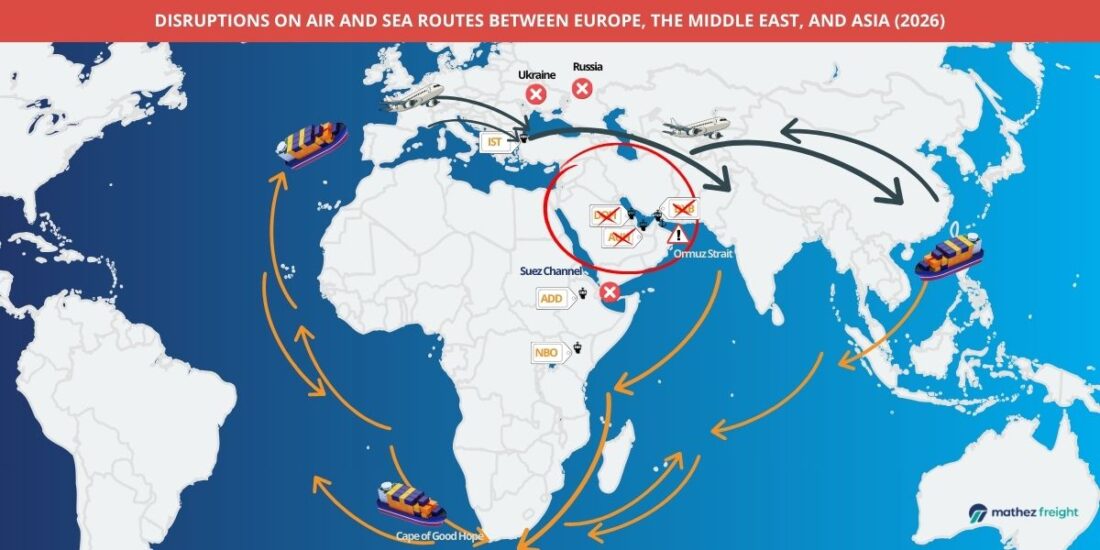
- The Strait of Hormuz is now classified as a very high-risk area. The majority of shipowners have suspended their services there, and around 170 container ships (450,000 TEU) are currently immobilized in the Persian Gulf. This blockage threatens the transit of 20% of the world’s crude oil and LNG production.
- At the same time, passages through the Suez Canal and the Bab el-Mandeb Strait, which had been gradually restored after the lull in Houthi attacks linked to the Israeli-Palestinian conflict, are once again suspended by all major carriers, for fear of a resumption of piracy operations.
- Ships heading for the Gulf have been instructed to take shelter until the area has stabilized.
Fleet reorganization and diversion via Africa:
To ensure the safety of crews and cargo, ships are rerouted via the Cape of Good Hope. Maersk, CMA CGM and Hapag-Lloyd have already confirmed this systematic route change. This detour considerably lengthens transit times (+10 to 15 days), and disrupts global rotations for weeks on end. The combination of longer journey times and vessels tied up in other areas drastically reduces the transport capacity available on the market, creating significant pressure on rates.
The Red Sea has once again become a no-go zone. For your Asia-Europe flows, the route via Africa is now the reference scenario, implying an immediate rise in your transport costs and a revision of your supply lead times.
Hub paralysis and congestion
- The port of Jebel Ali (Dubai) suspended operations following a fire caused by intercepted drone debris. Although operations have resumed, they are still running at a slow pace.
- Congestion at transshipment hubs: To limit risks, shipowners prefer out-of-area unloading. This pattern is expected to rapidly saturate the ports of Singapore, Tanjung Pelepas and Port Klang.
- Suspension of bookings: many shipowners(MSC, ONE, PIL, HMM, COSCO, OOCL, CMA CGM, Messina Line) have already temporarily suspended the acceptance of new bookings for all traffic to or from the Persian Gulf.
Heavy and immediate financial impact for shippers:
Since March 2, 2026, exceptional surcharges have been applied to cover increased risks and fuel costs:
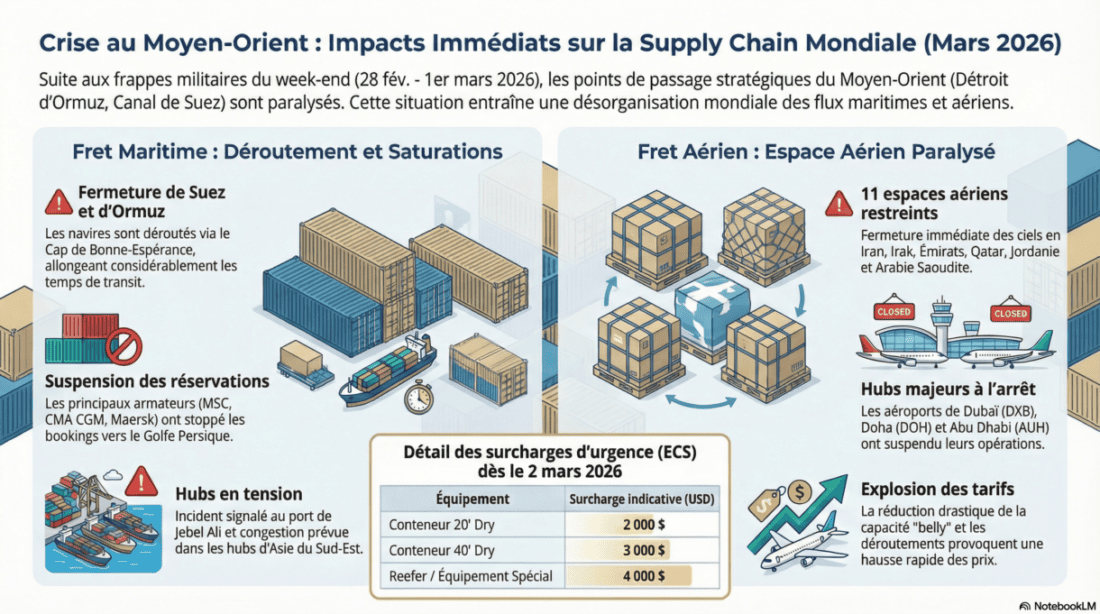
- Emergency Conflict Surcharge (ECS ): CMA CGM applies surcharges of USD 2,000 per 20′, USD 3,000 per 40′ and up to USD 4,000 for special or refrigerated equipment.
- War Risk Surcharge (WRS): Hapag-Lloyd has introduced a war risk surcharge of USD 1,500 per TEU.
- Port congestion and the disorganization of logistics chains should lead to a
- soaring sea freight rates, with knock-on effects on all
trade routes worldwide. - Higher fuel prices are expected to have a lasting impact on freight rates and on the global economy and trade as a whole.
Recommendations for chargers:
Against this backdrop of extreme volatility, logistics teams must:
- Systematically validate each new booking with your contacts before dispatch.
- Anticipate surcharges: Surcharges apply to bookings made on or after March 2, 2026, as well as to goods already afloat but not yet unloaded in the countries concerned. It is imperative to check the exact amount with each service provider, as these charges vary from company to company.Monitor detention charges related to sheltered vessels or closed ports.
- Anticipate extended delivery times by addingbuffer time to your schedules.
- Monitor detention costs related to sheltered ships or closed ports.
- Identify critical cargoes in order to evaluate, on a case-by-case basis, alternative solutions or transfers to European air freight, despite the strong pressure on prices.
- Specific restrictions: vigilance on temperature-controlled goods, with reefer bookings suspended to several Gulf and Red Sea countries.
"End of Voyage
On March 3, MSC declared an "End of Voyage" for all cargo bound for the Gulf. This means that cargoes will be unloaded at the next safe port instead of reaching their final destination.
MSC will apply a surcharge of 800 USD per container.
End of Voyage" is an exceptional contractual measure used by shipowners in the event of force majeure preventing the normal continuation of transport. The voyage is then considered contractually completed, even if the goods do not arrive at the scheduled port.
Once the cargo has been unloaded at the port of diversion, the risks, responsibilities and costs are transferred to the cargo owner. This can also result in the termination of transport insurance cover, leaving the goods unprotected for the rest of the journey.
This means that shippers, with the help of their forwarder, have to take care of post-carriage, including storage, handling, rebooking and new transport.
End of Voyage" is an exceptional contractual measure used by shipowners in the event of force majeure preventing the normal continuation of transport. The voyage is then considered contractually completed, even if the goods do not arrive at the scheduled port.
Once the cargo has been unloaded at the port of diversion, the risks, responsibilities and costs are transferred to the cargo owner. This can also result in the termination of transport insurance cover, leaving the goods unprotected for the rest of the journey.
This means that shippers, with the help of their forwarder, have to take care of post-carriage, including storage, handling, rebooking and new transport.
Air transport: airspace closures and loss of capacity
Air transport has come to a virtual standstill in the Middle East, turning the world’s transit hubs into chokepoints and sending shockwaves through international freight capacity.
Massive closure of airspace and hubs
The intensification of the conflict led to immediate and severe restrictions.
- No-fly zones: The airspace of at least 11 countries is closed or restricted, including Iran, Iraq, the United Arab Emirates (UAE), Qatar, Saudi Arabia, Jordan, Israel, Lebanon, Kuwait, Bahrain and Oman.
- Strategic hubs at a standstill: The major airports of Dubai (DXB), Abu Dhabi (AUH) and Doha (HAM/DOH) suspended operations, grounding their fleets.
- Routing complexity: To avoid conflict zones while complying with the Russian overflight ban, the remaining flights have to use narrow corridors to the north or south, resulting in major network disorganization and overloading Turkey and the Caucasus.
Widespread airline suspensions
Almost all international carriers have ceased operations in the region:
- Regional airlines: Emirates SkyCargo, Etihad and Qatar Airways have suspended their flights (initially until March 2 or 3, 2026). In particular, Emirates has imposed a 24-hour halt to bookings in order to stabilize its operations.
- European and international airlines: Air France/KLM, the Lufthansa group and British Airways have canceled flights to the Gulf and Tel Aviv, in some cases until March 8. Air India and IndiGo have cancelled hundreds of flights.
- Asian routes: Cathay Pacific, Singapore Airlines and Malaysia Airlines are suspending or diverting their flights to Dubai, Riyadh and Doha until March 7.
Over 2,000 flights were cancelled and 20,000 delayed in the space of 24 hours, representing almost 18% of total cargo capacity.
Critical consequences for air freight
The logistics sector has been hit by a sudden break in supply:
- Collapse of “Belly” capacity: The massive cancellation of passenger flights eliminates most of the hold freight capacity essential to global flows.
- Massive backlogs: Widespreadbooking stops are creating considerable delays. Experts predict that it will take several weeks to clear these backlogs once airspace reopens.
- Rerouting and costs: Shipments to Asia usually transiting via Doha or Dubai (i.e. up to 50% of certain traffic) are to be rerouted to European airlines, creating extreme price pressure. Freight rates are set to soar due to the scarcity of supply, longer journeys consuming more fuel, and a possible rise in the price of oil.
- Failure of the “Sea-Air” model: Dubai, which had banked on sea-air connectivity to strengthen the resilience of Asia-Europe supply chains, sees this global logistics hub totally paralyzed by the conflict.
21% of global air freight flows are directly impacted: 0.4% within the region, 2.2% export from the Middle East, 8.8% export, and 9.5% transit via the Middle East (source Aircargoweek).
Recommended action:
- Systematically validate each new reservation with your dedicated contacts before sending.
- Integrate large safety margins(buffer time) for all flows to or through the Middle East. Anticipate delays, stopover changes and frequent rotation adjustments.
- Consider alternatives for Urgent Freight: For critical flows to Asia, favor rerouting via European airlines, while anticipating strong pressure on rates and capacity. Solutions via Central Asia or southern airfreight corridors are being studied to bypass closed airspace (11 countries concerned).
Useful links
- TLF Overseas press release on the situation in the Middle East
- Visualization of maritime traffic with Marinetraffic
- Visualization of air traffic with OpenSky
- Visualization of possible air connections with Jetpaths (not including suspensions).
- Visualization of maritime traffic with Marinetraffic
- Visualization of air traffic with OpenSky
- Visualization of possible air connections with Jetpaths (not including suspensions).

In volatile environments, our account managers can help you react at a moment’s notice, identify alternative solutions and limit the financial impact of the crisis. Contact us for more information.
Frédéric Mercier, MATHEZ FREIGHT